Showing posts with label big Mondays. Show all posts

Monday, May 19, 2014

The Losers - 2003-206

I was trying to find something big but not TOO big to write about this week, and then it dawned on me - I could write about "The Losers" by Andy Diggle and Jock, which most of you have probably never heard about.

"The Losers" ran for 32 issues at Vertigo, its intended length. (For some strange reason, people often think the book got cancelled, even though the story ends exactly where it needs to...) It's collected in 5 slim trade paperbacks or 2 larger trade paperbacks, to tie in with the release of the movie, that wasn't terrible, but wasn't amazing either, despite a marvelous cast, but more on that in a bit.

It's a classic sort of revenge tale, with a group of spec ops troops getting revenge on their CIA handler who fucked them, but it's also got a lot of other big political elements that were relevant at the time, and a lot of which are still relevant now, including "the war on terror," race relations in the US, the CIA's involvement in global politics and a bunch of other stuff.

This is the book that put Andy Diggle on the scene for me as a writer, and I've mostly followed his writing career since this, although he's certainly one of the more up-and-down writers I tend to follow. Some of his projects have absolutely been amazing (such as his run on Hellblazer or his Green Arrow: Year One, a lot of which provided the foundation for the "Arrow" TV show) and some of them, well, some of them have not (*coughcough* AdamStrange *coughcough*). Mostly, though, Diggle's known for writing great dialogue and keeping stories spinning.

Jock's art, however, is certainly an acquired taste. I very much enjoy Jock's angular, almost chunky, style, because it usually fits for the type of material he's working on. It's noir-ish, and Jock has a very excellent grasp of how to darken in a scene, how to use lighting and how to give striking perspectives, but some people think his artwork is a little too raw for their liking, and I can understand that. Like I said, he's not an artist for everyone, but I dig him.

That's Jensen with the glasses..
"The Losers" is a fun tale in the tradition of "The Dirty Dozen," and the team of agents is all sorts of crazy. The plot takes a number of twists (and the last arc is maaaaaybe a bit bigger than some people can handle, a little too world super-villain and not enough grounded reality) and you're always going to be guessing where it's going to go next. The story is a complete package, though, so you'll have a nice resolved ending and feel like you've been on a big journey over the course of it. You can get the whole thing in "Book One" and "Book Two" on Amazon for your Kindle for $25, or in paper for $35 or so.

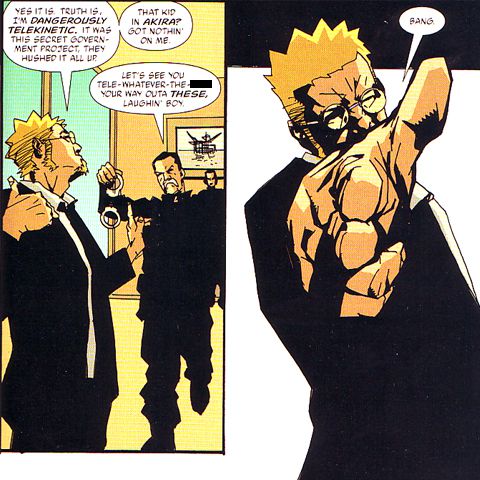
Now, about the movie... So here's the deal. It's got a lot of actors I really like in it - Idris Elba, Zoe Saldana, Jeffery Dean Morgan and Chris Evans (who basically steals the show in most of his scenes, and put him on the map for me, which made me psyched when he was announced as Captain America...) but it's... a good part of it's just a mess. The film is at its best when it's adhering closely to the source material, which means the helicopter bit at the beginning, Evans in the skyrise with the finger gun, the bits about the cash... but despite all of these amazing things they got right, oh my god what the living fuck is Jason Patric doing? Patric isn't a bad actor, but he's not even in the same movie. It's like the main cast gets they're doing "The Dirty Dozen" and Patric is convinced he's in "Batman & Robin"... you know, the one even Clooney is ashamed of. Also, the movie sticks to mostly the first act or two of the books, and the further it veers from the source material, the more it falls apart. If you're interested, read the books FIRST and then go back and watch the movie so you can enjoy the bits that are translated extremely well from the book (and to watch Evans actually dominate the role of Jensen) and then you can sort of let the rest of the stuff slide off your back...

Here's the trailer, to whet your whistle. Go buy the two books, even if the last act can get a bit operatic. You'll love them. I know I did.

Monday, May 12, 2014

Scott Pilgrim - 2004-2010

Some of you may have seen the awesome Edgar Wright film "Scott Pilgrim Vs. The Universe," but didn't know it was based on a comic book. Some of you may not have even seen that film. In both cases, you should correct your mistake, because Scott Pilgrim is all sorts of crazy awesomeness.

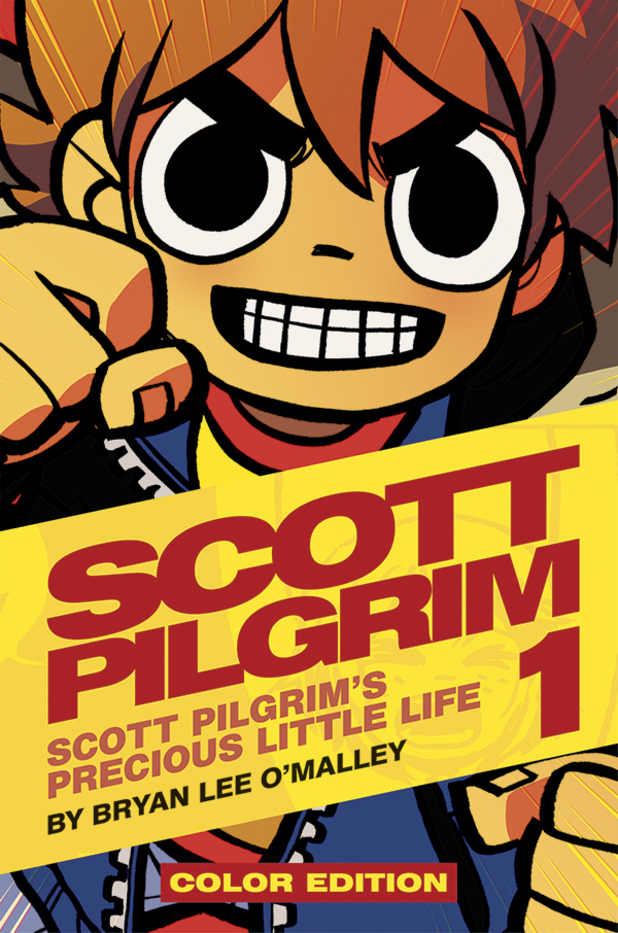
Scott Pilgrim is a series of six graphic novels by Bryan Lee O'Malley, which were originally done in black and white but are being colorized now (in addition to having a few extra scenes put back in). They detail the story of one Scott Pilgrim, a Canadian slacker and part-time bass player in the band Sex Bob-omb, who's trying to get his life together and win the heart of the beautiful American trans-dimensional delivery girl Ramona Flowers. To do so, however, he must defeat her seven exes, who have formed a league of sorts. (Because, y'know, bad guys tend to hang out together.) Oh, Scott's also sort of dating a high school girl when he meets Ramona, so there's that whole mess to figure out as well.

Scott Pilgrim is probably only targeted for people between the ages of 21-40, simply because a lot of the pop culture references will be lost on everyone else. That said, it's highly improbable than anyone will get all the references on their first time through, even someone as popped out as me. There's band references, comic book references, video game references (a LOT of videogame references), television references... it goes on and on. I mean, bad guys turn into coins when they're defeated. How can you go wrong with anything that has that in it?

O'Malley's art style is a blend of manga and traditional comic book art styles, and in what seems to be the default for the book, O'Malley just takes whatever works and folds it in, so you'll see things like screentones (which haven't been used in American comics for a long time now), exploding panels, full page spreads, caption jokes... it goes on and on.

Scott Pilgrim's greatest strength, however, is its characters, and not just Scott and Ramona. There's also Wallace Wells, Scott's "cool gay roommate," who often steals the scene in almost any scene he's in. (And props to actor Kieran Culkin for getting the role pitch perfect in the movie. And, y'know, also stealing the scenes he's in...) And there's Kim Pine, Scott's high school friend (and his first girlfriend), the band's drummer who's angrier than most people would believe. Also, Knives Chau, the high school girl who's referred to as "Scott's fake high school girlfriend" early on in the book. And plenty others. Not to mention the evil exes, who are wildly diverse and mostly insane.

There's something wonderfully stop-and-start about Scott Pilgrim as both a character and a book. When it's moving forward, it feels like forward motion is the only possible thing that could be happening right then and there. When it's dwelling on a moment, you almost want that moment to last forever. And Scott as a character is the exact same way - he doesn't seem to have any 1st gear, only neutral and 4th.

And, if you haven't seen the movie "Scott Pilgrim Vs. The World," you really should. It's from Edgar Wright, who's brought you such pop classics as "Shaun of the Dead" and "Hot Fuzz," and who's directing "Ant-Man" for Marvel. (He also did a marvelous TV show called "Spaced," but I'll talk about that another day.) I've never understood why the film wasn't a monster hit, but maybe it was just too clever for its own good, a distinct possibility considering the film makes fun of hipsters more than a little bit...


The whole series is out in black and white now, and the first four volumes are in color, with the fifth one coming in June and the sixth one probably the end of this year or the beginning of next (although it could be next summer. Who the hell knows.)

Monday, May 05, 2014

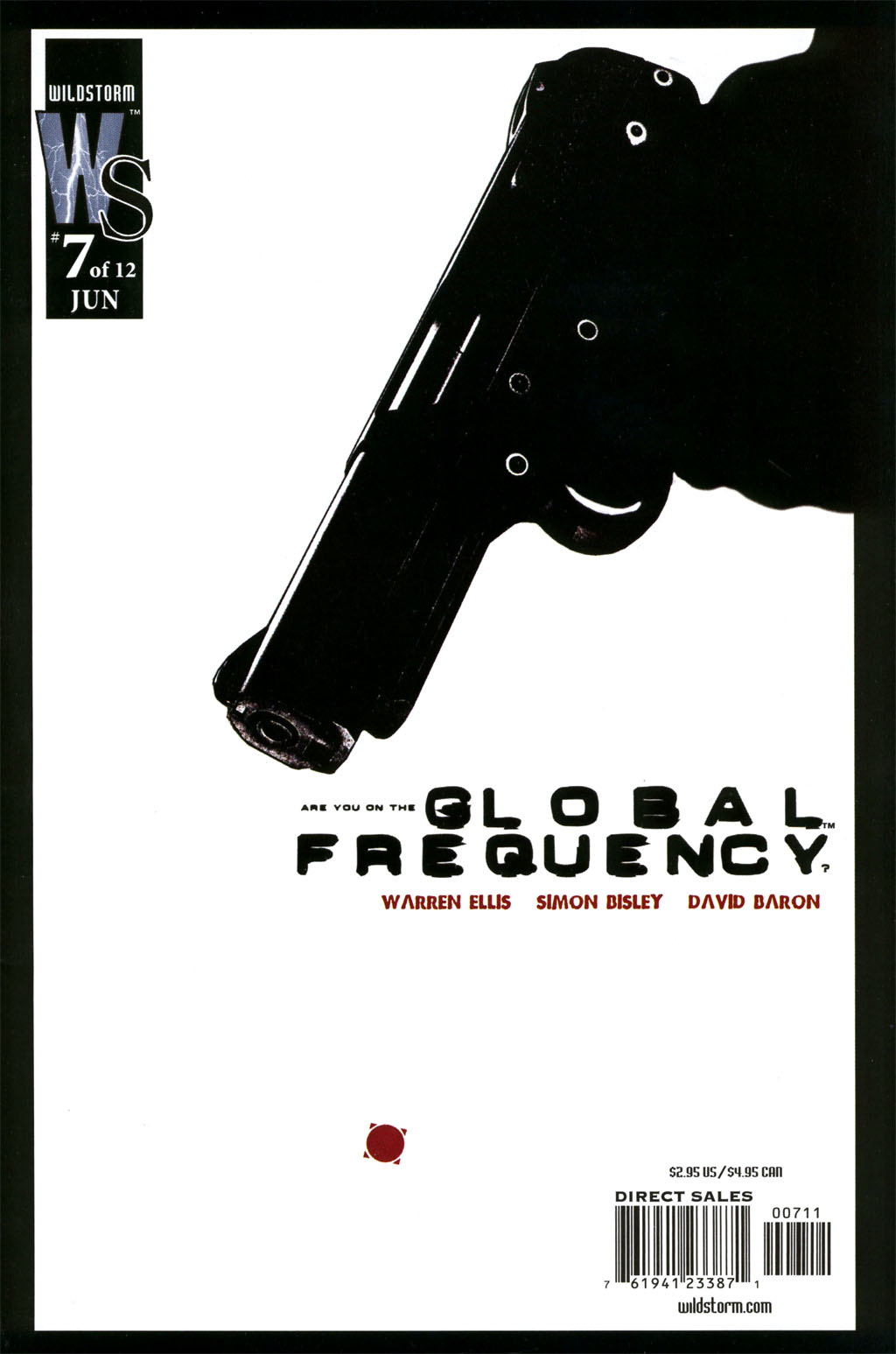
Global Frequency - 2002-2004 - Warren Ellis

"You're on the Global Frequency."

I imagine I'm going to cover most of the series Warren Ellis has finished on the blog at some point - that's a notable distinction, as he's also just abandoned a number of them - but I wanted to start with Global Frequency for a number of reasons.

First and foremost, Global Frequency is twelve issues, meaning it's not a big investment (you can pick up the whole series in one trade paperback for $15 from Amazon) and it's not a major time commitment.

Next, Global Frequency is independent of everything. It, ostensibly, exists inside our world. No superheroes, no folks in tights, no endless backstory for you to have to go digging into. Twelve issues. You're in; you're out.

Also, each issue is illustrated by a different artist, so if you find you aren't connecting with a particular style, for whatever reason (I've known people like this over the years - they can't read a comic, no matter how good it is, because they don't like the artist's style - I've never understood it), you just need to make it to the next issue. Or even just skip to the next issue. The stories are, mostly, self-contained. Each issue will give you a part of a bigger picture, but isn't necessary to enjoy any of the other stories. Although, you probably want to read the first one to get a good sense of what the concept of the book is. But I'll clue you in on that too.

There exists an independent intelligence agency known as the Global Frequency. There are 1,001 members. It was founded by Miranda Zero, who was clearly an intelligence agent... somewhere, before this. Everyone on the frequency is activated by a cell phone when they are needed by the operator known as Aleph, who is the communications hub for Global Frequency. Agents don't know anything about each other until they are activated. Each person on the frequency was chosen for a skillset and/or a region of influence.

When a crisis arises, Zero selects a team, Aleph activates it and away they go.

If it sounds a little bit like Mission: Impossible for the modern era, you aren't wrong. Ellis specifically designed the series to function like television, with each episode being self-contained so that people could drop in or drop out at a moment's notice. Also, it granted Ellis a lot more leeway in story-telling. Only Aleph and Miranda Zero were considered "safe" characters - anyone else could be killed off without warning, because it wasn't like you'd see them next issue any way. It was also planned to be exactly twelve issues, so that Ellis could work with all the available artists he had that he wanted to at the time, and then be done. He's threatened to do a sequel for a long time now. He really ought to get his ass on that.

Another part of what makes Global Frequency so damn good is that it taps into Ellis' almost fetishistic interest in beyond-the-pale technology and philosophy. Because of the concept, he could dabble in things like advanced prosthetics, Cold War psychotropic drug studies conducted by the military, mass hallucinations, etc. Each issue is framed around a "big idea" that the rest of the story hangs on, but keep in mind, "big idea" can sometimes be something as simple as parkour, which has become pretty widespread in mainstream media since then. (Although in my opinion, no one's really ever topped District B13 in that regard, but that's a post for another day.) Ellis uses the spy framework to build stories that deal with bigger questions, the sorts of questions you don't see people often asking in comics these days. And all of this on an action thread that really sings, whizzing along at top speed.

After reading Global Frequency, you may find yourself thinking that it's screaming for adaption to television, and you're not wrong. But it's been tried. John Rogers (one of the two people behind "Leverage," the best damn TV show not enough people watched) wrote and executive produced a pilot that you can find floating around the internet that was great. It was an adaptation of the first issue, but changed things around so there would be a couple more stable characters, as television often seems to need. It didn't get picked up for series. Then in 2009, supposedly the CW was looking at trying to have a go at it again, but that's half a decade ago and nothing came of it, so maybe television's overlords don't understand how badly we want it.

Then again, Ellis has supposedly been working on a number of stealth projects as of late, some of which are television related, so I can hope...

Until then, you should pick up Global Frequency and see what mad scientists will be up to in the next couple of years. Because some of the concepts he puts forth are frighteningly plausible...

Monday, April 21, 2014

The Boys - 2006-2012

So on Mondays I'm going to talk about larger things, starting with today. Today I want to talk to you about "The Boys," but first, absolutely no kids allowed on this one, because "The Boys" has absolutely everything in it that parents probably want them to steer clear of.

Over the top violence? Check. Sex with body parts drawn? Check. Profanity? Abso-fucking-lutely. A cast of characters where lots of them are pretty appalling people? You bet. A cynical world-view that can, at times, be bleak and oppressive? Damn straight. But you'll also get some of the finest gallows humor, superhero deconstruction and effective storytelling that's ever hit the comic book pages.

"The Boys" began its life over at DC/Wildstorm, and saw all of six issues published there before the book was cancelled, but it was picked up shortly thereafter by Dynamite Entertainment, and quickly became one of that publisher's most successful titles.

DC, it turns out, thought maybe it was a little too dark for them, although they really should have known what they were signing on for. After all, the two creative forces behind "The Boys" were writer Garth Ennis, whose "Preacher" was one of the biggest smashes DC's other imprint Vertigo ever had, and artist Darick Robertson, who with writer Warren Ellis had done "Transmetropolitan" with Vertigo (and believe you me, we'll do "Transmetropolitan" on one of our big Mondays sometime soon).

These were two guys who didn't want to push the envelope, they wanted to rip the damn thing up. But the violence and profanity in the first few issues of The Boys weren't really that far past what the other two series had done. It wasn't until the book relaunched over at Dynamite that it went from a hard-R to the NC-17 nasty masterpiece that it is. So what was the problem that got them cancelled from Wildstorm?

Ennis has said in interviews since that DC was really uncomfortable with the anti-superhero tone of the book, and that moving to Dynamite was what let the book to thrive, because they weren't on the hook to anybody over there. Dynamite didn't want them to reign it in - they wanted them to let loose. Nudity, violence, profanity - let loose the dogs of war, if you will. Dynamite wanted to see what Ennis would do with no one around to tell him "no." And that was that. "The Boys" could let its freak flag fly as high as it wanted to.

See, "The Boys" is really an upending of the apple cart that is superheroes. It's a book that takes the core conceit of superhero stories and gives it a good old slap on the ass. "The Boys" are a CIA sponsored unit whose job is to keep superheroes in check when possible, and to "deal" with them when not. When superheroes sprung forth into the world, they became instant celebrities. Some of them dealt with it better than others. "The Boys" are given a chemical to turn them into super-powered beings, so they can handle superheroes, but really, this just means they're insanely strong and tough. In many ways, "The Boys" are old-school legbreakers. And that's part of what makes this series so goddamn entertaining.

There are five members of "The Boys." First and foremost, there's Butcher. Billy Butcher is the leader of The Boys, and has been around the longest. He's loosely based around Michael Caine in "Get Carter." He's friendly, jovial even, but you also know right away that he is absolutely deadly. He's a soldier. You'll know that right at the start.

Next is Mother's Milk. He's sort of Butcher's right hand man. He's the only American on the team. He's an ex-Ranger, ex boxer. If they ever get a movie off the ground, I can see someone like Terry Crews playing him. Despite being probably the nicest guy on the team, he's ... got lots of family issues. On a lot of levels.

You have The Frenchman. He's crazy. He's scrawny. He's also half of the team's "muscle," because he's pretty insanely ruthless. He's fun, simply because you're never exactly sure how much is an act and how much is genuine psychosis.

There's The Female. She never speaks. She's the most deadly member of the team. She's also the most mysterious, and throughout the whole of the series, you still won't learn all that much about her. A little, yes, but probably not as much as you think you're going to.

And lastly, and perhaps most importantly, there's Wee Hughie, who is modeled after British actor Simon Pegg. Hughie is the new guy to the team, and the book opens with his recruitment, and it's through his eyes we get introduced to the world of "The Boys" when a superhero accidentally kills his girlfriend right in front of his eyes, and sends him into shock. Hughie is the character we come to know the most, and best, through the course of the series. And while he goes through some changes, probably the most impressive thing about Hughie is that at the end of the day, he's always Hughie.

At the opening of "The Boys," Butcher is starting to get the gang back together, but Mallory, the other co-founder of the group, isn't interested in rejoining, so this is why Butcher gets Hughie. Because The Boys needs to be a group of five.

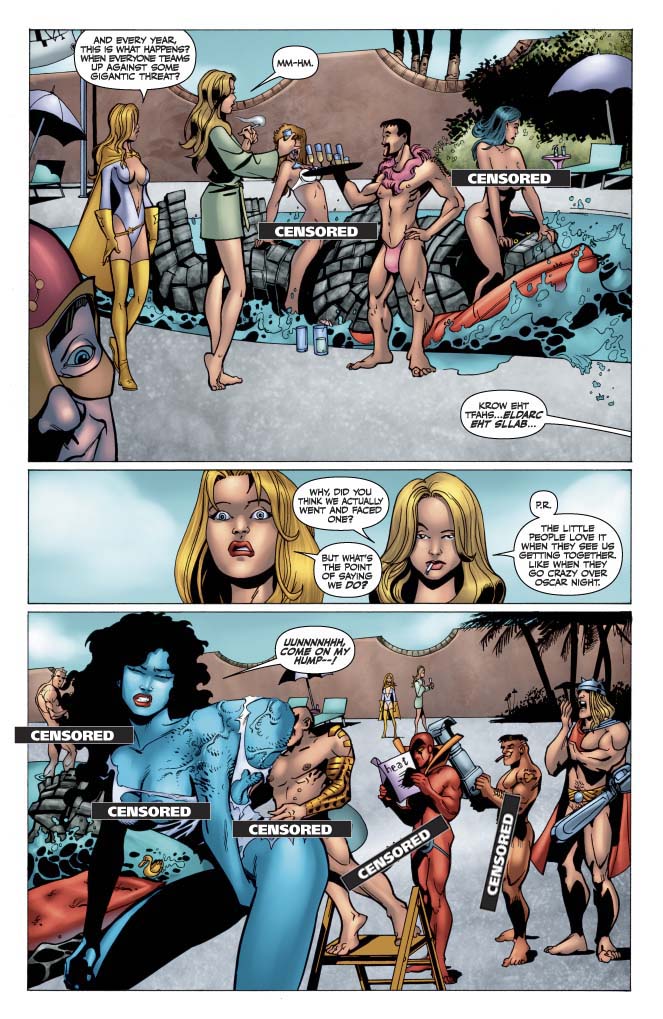
I don't want to tell you too much about the whole story, but I can tell you a few things - you'll end up seeing parodies/homages to many familiar hero archetypes, and the more invested in comics you are, the funnier all of this will be. You'll see things that will remind you of characters from both of the two big houses, as well as a bunch of stuff you know they'd never dare to print. I mean, shit, one of the arcs of the series is called "Herogasm." You can extrapolate for yourself what to expect from that, I imagine.

This isn't a short story, so you'll probably want to delve in a little bit at a time. All said and done, "The Boys" has been collected in 12 trade paperbacks, or 6 oversized hardcovers. (In researching this article, I found there will also be "omnibus" editions in the near future, starting in July. Best guess from the description/page count is that there will be 4 or 5 of those.)

I know that sort of commitment can sound intimidating, but you should trust me on this - it's worth it. If you pick it up in collected form, in any collected form, you'll get all 72 issues of the main "The Boys" comic, and the three miniseries - "Herogasm," "Highland Laddie" and "Butcher, Baker, Candlestickmaker" - in their correct placement in the series. You'll get the sort of big screen epic that you really can't get from the big two.

For a long time, I wondered why most superhero stories never felt all that, well, real. After The Boys, I understood why. Don't get me wrong - I love superheroes, but when you see them in a horrible warts-and-all approach, where a few of them are good, most of them are indifferent and a bunch of them are kind of assholes, you start to see superheroes as the people rather than the mask. But even with that, The Boys has a great big storyline full of twists and turns, of horrible things but also of love and heroism, the true kind.

Still hesitant? Here, you can go read all of issue one, free and online, from the publisher, to whet your appetite - just click here. (It looks like there's a bit of a problem with it when I loaded it up, so your mileage may vary, but it'll give you an idea of what you're in for.) Trust me, if you like your stories dark and feral and sticky with just a hint of nobility around the edges, it's hard to beat The Boys.