Showing posts with label movies. Show all posts

Monday, May 19, 2014

The Losers - 2003-206

I was trying to find something big but not TOO big to write about this week, and then it dawned on me - I could write about "The Losers" by Andy Diggle and Jock, which most of you have probably never heard about.

"The Losers" ran for 32 issues at Vertigo, its intended length. (For some strange reason, people often think the book got cancelled, even though the story ends exactly where it needs to...) It's collected in 5 slim trade paperbacks or 2 larger trade paperbacks, to tie in with the release of the movie, that wasn't terrible, but wasn't amazing either, despite a marvelous cast, but more on that in a bit.

It's a classic sort of revenge tale, with a group of spec ops troops getting revenge on their CIA handler who fucked them, but it's also got a lot of other big political elements that were relevant at the time, and a lot of which are still relevant now, including "the war on terror," race relations in the US, the CIA's involvement in global politics and a bunch of other stuff.

This is the book that put Andy Diggle on the scene for me as a writer, and I've mostly followed his writing career since this, although he's certainly one of the more up-and-down writers I tend to follow. Some of his projects have absolutely been amazing (such as his run on Hellblazer or his Green Arrow: Year One, a lot of which provided the foundation for the "Arrow" TV show) and some of them, well, some of them have not (*coughcough* AdamStrange *coughcough*). Mostly, though, Diggle's known for writing great dialogue and keeping stories spinning.

Jock's art, however, is certainly an acquired taste. I very much enjoy Jock's angular, almost chunky, style, because it usually fits for the type of material he's working on. It's noir-ish, and Jock has a very excellent grasp of how to darken in a scene, how to use lighting and how to give striking perspectives, but some people think his artwork is a little too raw for their liking, and I can understand that. Like I said, he's not an artist for everyone, but I dig him.
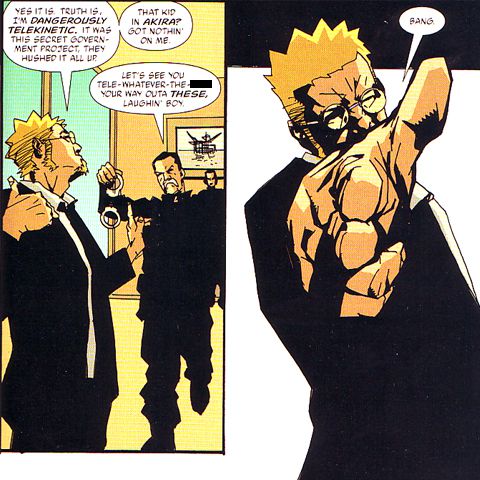
That's Jensen with the glasses..
"The Losers" is a fun tale in the tradition of "The Dirty Dozen," and the team of agents is all sorts of crazy. The plot takes a number of twists (and the last arc is maaaaaybe a bit bigger than some people can handle, a little too world super-villain and not enough grounded reality) and you're always going to be guessing where it's going to go next. The story is a complete package, though, so you'll have a nice resolved ending and feel like you've been on a big journey over the course of it. You can get the whole thing in "Book One" and "Book Two" on Amazon for your Kindle for $25, or in paper for $35 or so.

Now, about the movie... So here's the deal. It's got a lot of actors I really like in it - Idris Elba, Zoe Saldana, Jeffery Dean Morgan and Chris Evans (who basically steals the show in most of his scenes, and put him on the map for me, which made me psyched when he was announced as Captain America...) but it's... a good part of it's just a mess. The film is at its best when it's adhering closely to the source material, which means the helicopter bit at the beginning, Evans in the skyrise with the finger gun, the bits about the cash... but despite all of these amazing things they got right, oh my god what the living fuck is Jason Patric doing? Patric isn't a bad actor, but he's not even in the same movie. It's like the main cast gets they're doing "The Dirty Dozen" and Patric is convinced he's in "Batman & Robin"... you know, the one even Clooney is ashamed of. Also, the movie sticks to mostly the first act or two of the books, and the further it veers from the source material, the more it falls apart. If you're interested, read the books FIRST and then go back and watch the movie so you can enjoy the bits that are translated extremely well from the book (and to watch Evans actually dominate the role of Jensen) and then you can sort of let the rest of the stuff slide off your back...

Here's the trailer, to whet your whistle. Go buy the two books, even if the last act can get a bit operatic. You'll love them. I know I did.
Monday, May 12, 2014

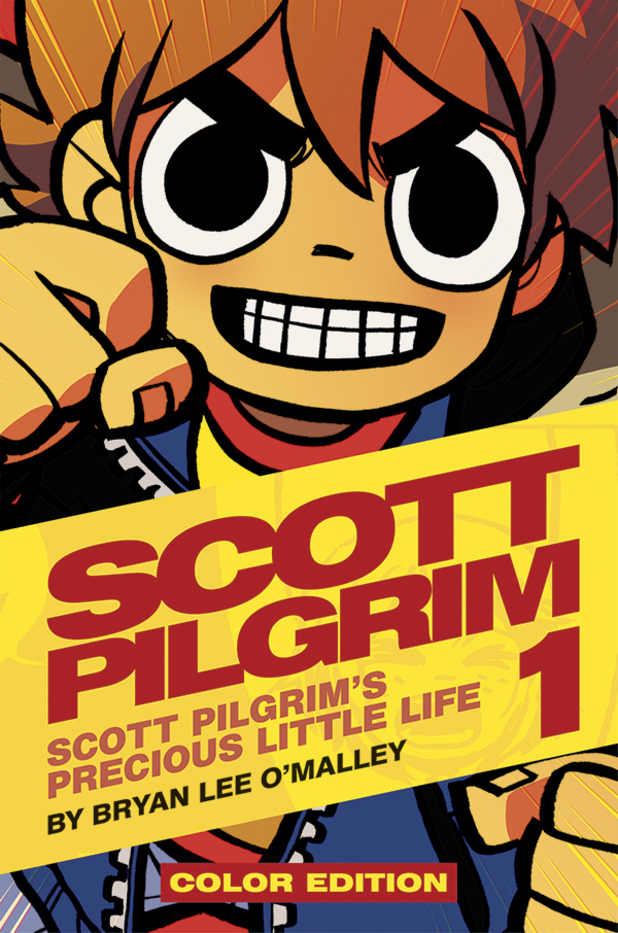
Scott Pilgrim - 2004-2010

Some of you may have seen the awesome Edgar Wright film "Scott Pilgrim Vs. The Universe," but didn't know it was based on a comic book. Some of you may not have even seen that film. In both cases, you should correct your mistake, because Scott Pilgrim is all sorts of crazy awesomeness.

Scott Pilgrim is a series of six graphic novels by Bryan Lee O'Malley, which were originally done in black and white but are being colorized now (in addition to having a few extra scenes put back in). They detail the story of one Scott Pilgrim, a Canadian slacker and part-time bass player in the band Sex Bob-omb, who's trying to get his life together and win the heart of the beautiful American trans-dimensional delivery girl Ramona Flowers. To do so, however, he must defeat her seven exes, who have formed a league of sorts. (Because, y'know, bad guys tend to hang out together.) Oh, Scott's also sort of dating a high school girl when he meets Ramona, so there's that whole mess to figure out as well.

Scott Pilgrim is probably only targeted for people between the ages of 21-40, simply because a lot of the pop culture references will be lost on everyone else. That said, it's highly improbable than anyone will get all the references on their first time through, even someone as popped out as me. There's band references, comic book references, video game references (a LOT of videogame references), television references... it goes on and on. I mean, bad guys turn into coins when they're defeated. How can you go wrong with anything that has that in it?

O'Malley's art style is a blend of manga and traditional comic book art styles, and in what seems to be the default for the book, O'Malley just takes whatever works and folds it in, so you'll see things like screentones (which haven't been used in American comics for a long time now), exploding panels, full page spreads, caption jokes... it goes on and on.

Scott Pilgrim's greatest strength, however, is its characters, and not just Scott and Ramona. There's also Wallace Wells, Scott's "cool gay roommate," who often steals the scene in almost any scene he's in. (And props to actor Kieran Culkin for getting the role pitch perfect in the movie. And, y'know, also stealing the scenes he's in...) And there's Kim Pine, Scott's high school friend (and his first girlfriend), the band's drummer who's angrier than most people would believe. Also, Knives Chau, the high school girl who's referred to as "Scott's fake high school girlfriend" early on in the book. And plenty others. Not to mention the evil exes, who are wildly diverse and mostly insane.

There's something wonderfully stop-and-start about Scott Pilgrim as both a character and a book. When it's moving forward, it feels like forward motion is the only possible thing that could be happening right then and there. When it's dwelling on a moment, you almost want that moment to last forever. And Scott as a character is the exact same way - he doesn't seem to have any 1st gear, only neutral and 4th.

And, if you haven't seen the movie "Scott Pilgrim Vs. The World," you really should. It's from Edgar Wright, who's brought you such pop classics as "Shaun of the Dead" and "Hot Fuzz," and who's directing "Ant-Man" for Marvel. (He also did a marvelous TV show called "Spaced," but I'll talk about that another day.) I've never understood why the film wasn't a monster hit, but maybe it was just too clever for its own good, a distinct possibility considering the film makes fun of hipsters more than a little bit...


The whole series is out in black and white now, and the first four volumes are in color, with the fifth one coming in June and the sixth one probably the end of this year or the beginning of next (although it could be next summer. Who the hell knows.)

Monday, April 28, 2014

Queen & Country - Greg Rucka - 2001-2007

It's no secret I love me a good spy story. The problem is that the comics world has, surprisingly, not a whole lot of good ones. Oh sure, we get a few odds and ends here and there, and I treasure each one that we get, but often they don't run long, or they tend to gloss over the sorts of stuff I find fascinating.

Greg Rucka's "Queen & Country" wasn't short and it wasn't afraid to get down to the nitty-gritty.

The series ran from 2001 to 2007 from Oni Press, and focused on SIS, the Special Intelligence Service for Her Majesty's Government, aka England. The main protagonist is Tara Chace, one of the Minders, aka the field agents.

Q&C draws its inspiration from a British television show called "The Sandbaggers," which aired from 1978 to 1980, when its creator, Ian Mackintosh, mysteriously disappeared. Seriously, you have no idea how much like a spy story the man's disappearance is. According to reports, he and two others were flying over the Gulf of Alaska, they made a short unscheduled stop at an old WWII era disused airfield, then shortly after, send a brief mayday signal and vanished.

The report was that the plane had crashed and all aboard were lost at sea. But there have been a bevy of unanswered questions about that day, wreckage was never found, and a guy even wrote a book about it. The prevailing theory is that Mackintosh is either living a new life somewhere or defected to Russia. No one's really sure. The hope was that there would be more clarity in 2013 after some things were declassified, but I haven't seen any real updates, so it looks like his fate is still unknown. How cool is that?

Part of the appeal of both Q&C and Sandbaggers is that they are very authentic portrayals of espionage work, i.e. there's lots of office work, planning, sitting around, discussing things, in addition to the more standard action fare.

Sure, James Bond is the go-to for showcasing big splashy set pieces, but actual espionage work has a lot of sitting and waiting, having to be ready, for when those moments of action do occur, they're often sudden and without warning, and there's no time for hesitation. It's hurry up and wait in the best and worst possible way.

And the office politics, oh man, don't get me started. You think your office has complicated squabbles... imagine if you knew that everyone you were arguing with was a trained soldier with high intelligence, excellent marksmanship and occasionally flexible morality, as needs might call for. And then throw in the fact that the government you work for doesn't often know what to do with you or your team, isn't sure they're making the right calls, wants to think about things forever, wants to second guess you and your information, and reserves the right to insult you if anything goes wrong, whether or not you listened to them in the first place. It's not just a nest of vipers, it's the whole damn pit.

Another part of what makes Q&C so compelling is Chace herself, who is both highly capable and an utter mess, as it feels like many people in the espionage field are. We see Chace, warts and all, being dangerous and smart, and yet still coping with personal problems and political struggles. 

After the series' conclusion, Rucka's written three novels continuing the stories, but I've always felt that Q&C sung better in illustrated format. That said, there's been the potential of a movie circling around for a while, with Ellen Page supposedly in negotiations to play Chace, and a director officially being announced in March, but as with all comic book translations, I won't believe a word of it until I hear the movie's actually filming.

Q&C isn't the only successful espionage comic, but it's certainly had one of the longest runs, and it's easy to pick up, in 4 collected volumes, and all three novels are easily available as well.

Thursday, April 24, 2014

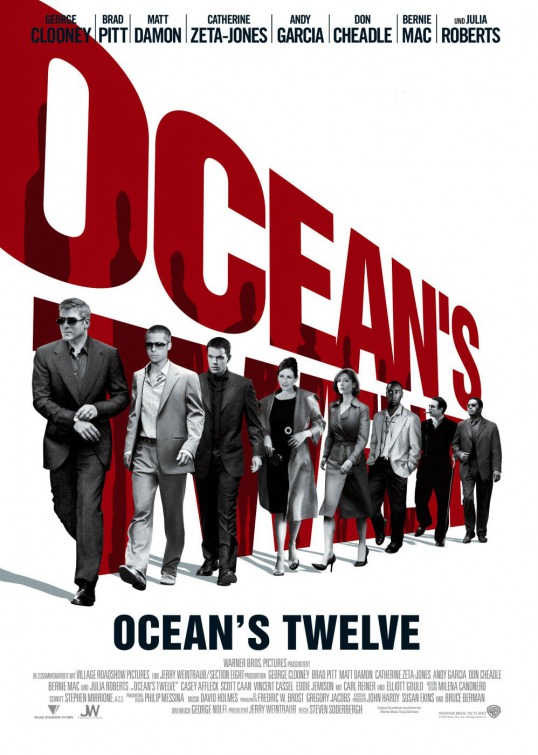
Ocean's Twelve - 2004

I fully expect a bunch of people to disagree with me on this one, but I think "Ocean's Twelve" is a good movie.

I know, I know, I can hear people now. "I didn't like it as much as 11, or 13!" "It wasn't the same kind of movie!" "Entertainment Weekly put it on their list of 25 Worst Sequels Ever!" Well, just because you didn't like it as much as 11 or 13 doesn't mean it isn't a good movie. And yes, it was a different kind of movie. (And Entertainment Weekly is full of shit on this one.)

See, the first "Ocean's" film in the modern era was meant to be an homage to the swinging sixties. When they came back to do "Thirteen," they did another sixties style film, akin to the first one. But "Twelve" is something rather different. "Twelve" is a seventies-style European movie.

If you look at even the very way that 11 and 13 are shot, and compare them to 12, you'll see the difference immediately. All three films use very saturated color and bright palettes, but 11 and 13 are very crisp looking movies, whereas a lot of 12 is very grainy. 11 and 13 are going for pop, and 12 is going for a low sizzle. Much of 11 is set under the neon jungle of Las Vegas, but 12 is set all over Europe.

Also, I appreciate all of the short hand that stuck around from the first movie. We get to see Danny and Rusty finishing each other's sentences, and it reinforces point that these guys know each other so very well. And the scene of all the guys arguing about how Benedict called it "Ocean's Eleven" is absolutely priceless. "It's just, I thought we agreed to call it The Benedict Job." Man, it kills me every time.

In the end, I think people were expecting 12 to be exactly like 11, and that isn't what happened. Each of the three films is somebody's movie. The first film is Danny's movie. The last film is Reuben's movie. And the middle film, well, it's Rusty's movie. Everything is a little more complicated, a little more likely to go off the rails, and requires a little bit more trust. Those of you who only saw it once, go back and watch it again, and try to keep an open mind about it this time. I think you'll be surprised how good it is...

Thursday, April 03, 2014

Shallow Grave - 1994

Obi-Wan Kenobi and Doctor Who fight over how to get rid of a dead body in their apartment, and what to do with all of the money found on said dead body.

There, I've just sold you on "Shallow Grave." Post done.

... You're still here? Fine.

"Shallow Grave" is a 1994 film, the first from director Danny Boyle, that tells the story of three people - Christopher Eccleston (aka The Ninth Doctor), Ewan McGregor (aka Obi-Wan Kenobi) and Kerry Fox (who never really took a genre busting role) - who share a flat in Edinburgh, but need to take on a fourth roommate in order to pay the bills. They interview people and eventually choose this guy to be their new roommate. Not long after, they find him dead. And in his room, they find a suitcase full of cash.

I really don't want to tell you more about the plot that this, because to do so would be to spoil the fun of the movie. It's a dark comedy, or a thriller with comic elements, whichever you like. It's the first major film role of Ewan McGregor, and he and director Danny Boyle would go on to make "Trainspotting" a few years later, and that would vault both to superstardom.

The film is gorgeously shot, and it was a big hit in the UK, although it didn't really make it's way over here until Trainspotting was hitting, and by that point, everyone knew that Boyle and McGregor were going to be big things. It moves at a mile a minute, and it shifts tones quick and crazy. It's also wildly macabre and gets very dark, so you have to be prepared to roll with the punches. But it's a film I absolutely love, and you'll get a kick out of it.

Monday, March 31, 2014

Night Watch - 2004, Day Watch - 2006

Even if director Timur Bekmambetov never returns to finish this trilogy, "Night Watch" and its sequel "Day Watch," are two of the most visually arresting urban fantasy-horror films ever made, and they launched a director whose talent cannot be ignored (even if he sometimes slums it with things like "Abraham Lincoln: Vampire Hunter").

You've never really seen anything like Night Watch before - it's almost as though Tony Scott and Tim Burton had a directing child. Bekmambetov paints in gorgeous colors, brilliant and vivid, lush gardens of visual delight, but also moves through them with a stop-start rhythm that can be a little jolting your first time through. The two films are a mix of fantasy and horror, stories set in modern Russia. And the special effects, oh lord, the special effects.

See, Bekmambetov wanted to do special effects, but he wanted to do them his way, so he actually founded a special effects company in Russia, to set the tone and do the primary visual effects for his stuff. (He started as a commercial director, like many amazing directors.) So you will see things in Night Watch that you have never seen before. Like someone's head turning transparent and leaving only the veins and arteries visible inside of it. Seriously, this is the kind of thing he does.

Night Watch is based on a series of Russian urban fantasy novels from Sergei Lukyanenko, with the first movie fairly closely lining up with the first two parts of the first novel and the second movie Day Watch actually being based on the third act of the first novel as well. The novel series is a pentalogy and the fifth book, "New Watch," is actually coming out here in the states this month. (The books, in order, by the way, are "Night Watch," "Day Watch," "Twilight Watch," "The Last Watch," and "New Watch.") Keep in mind, the movie does take some liberties with the source material, but that's par for the course for Bekmambetov's adaptations. He changed so much of "Wanted" from the graphic novel to the film that the two aren't even in the same state, much less the ballpark. And there's talk of a Wanted sequel, although it seems like that project is in the are-they-or-aren't-they state more often than a Schrodinger cat.

The premise of Night Watch is that in ancient times, a group known as The Others (who are sometimes interpreted as angels and demons) cause a great battle with man caught in the middle. Eventually, a truce is struck and both sides form their own special army to keep an eye on the other. The light side forms the Night Watch and the dark side forms the Day Watch. And that balance has held for centuries, but now things are going to get complicated. The story features witches, shapeshifters, vampires, curses and more...

Make no mistakes about it, Night Watch and Day Watch can be somewhat convoluted. The stories are full of twists and turns, there's a lot of characters, and while you should be watching it subtitled, there's a lot going on at any given moment, so you may need to watch some scene multiple times, to pick up everything that's going on.

You probably should watch the two of them as a pair, as they really are two halves of one film. I was originally just going to write about Night Watch today, and then I realized the more I thought about it, the more sense it made to just treat the two pieces as one whole (like Tarantino's "Kill Bill" for example) because either half by itself will leave you a little unfulfilled, but watching the two will give you a full sense of the whole story.

I leave you with the two trailers, Night Watch and Day Watch. (Oh, also starting this week, I'm going to just be doing this blog five days a week - I'm going to take Saturdays and Sundays off so I can get ahead a little bit, and not be scrambling so much. I figure it'll still give you an endless cavalcade of things to be getting your enjoyment on with.)


Sunday, March 30, 2014

City On Fire - 1987

Not a lot of people stateside have seen "City On Fire," the 1987 film from Ringo Lam starring Chow Yun-Fat, which is a pity. I've often been surprised that Ringo Lam's movies haven't gotten more recognition over here, especially the ones starring Chow Yun-Fat, but in particular, I've always been especially astonished that more people haven't seen City On Fire, because most people I know have seen the film it "inspired" - Quentin Tarantino's "Reservoir Dogs."

Don't get me wrong - I love Reservoir Dogs as a film, but after seeing City On Fire (which I did see after Dogs), I was a little astonished how much of the movie is lifted wholesale. Let me tell you the basic plot of City On Fire and see if it sounds at all familiar.

Chow Yun-Fat is a cop, who is tasked with infiltrating a bunch of jewel thieves. He's been chased by cops, most of whom don't know he's an undercover cop. And he starts to bond with the very gang of thieves he's meant to be infiltrating. Then things go horribly awry.

There are a lot of differences between the two movies, but the two are alike enough that a guy on YouTube created a 10 minute film called "Who Do You Think You're Fooling?" which shows how strikingly similar the two movies are, down to overlaying large swaths of Dogs' dialogue over City On Fire. In fact, it's almost as if the two movies fold together to make one big movie. (A lot of the things that are related in Dogs are the events that actually happen in City.) But both films eventually come to the entire same last act - a bunch of criminals attempting to figure out what went wrong, and who the cop that's infiltrated their group is.

Regardless of how much of the movie is lifted wholesale, City On Fire is a great Hong Kong film that isn't from John Woo (but still stars Chow Yun Fat, who is one of those actors I will watch in just about anything...) and is absolutely worth your time.

Saturday, March 29, 2014

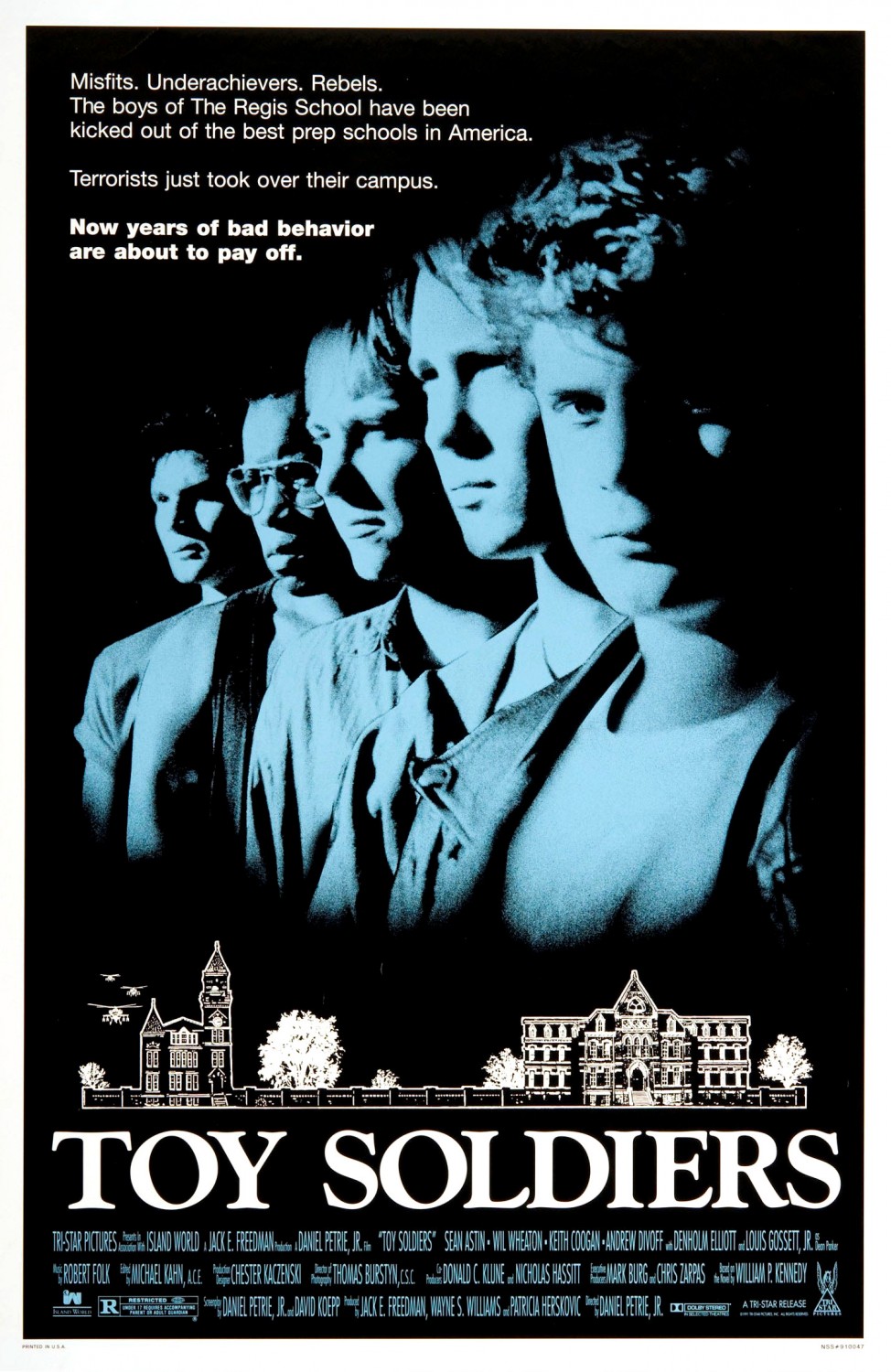
Toy Soldiers - 1991

There are a number of movies in this blog that I talk about that aren't necessarily great films, but they're fun movies. "Toy Soldiers" is one of those movies.

It stars a bunch of people you've seen in lots of things - Sean Astin, Wil Wheaton, Denholm Elliot, Keith Coogan, Louis Gossett Jr., Mason Adams... hell, it's got R. Lee Ermey in it! (You'll remember him as the insane drill instructor from "Full Metal Jacket." Everyone does.)

The premise of the film is that terrorists take over a private boarding school full of the worst of the worst rejects, the people who've been kicked out of lots of other boarding schools.

They decide they're going to fight back.

Now, keep in mind, despite the semi-campy concept, this is a thriller. There are parts of it that can be lighthearted, but this is a film that isn't afraid to show people getting killed, and isn't afraid to shirk away from the consequences of people's actions. It's shot in that sort of minimalistic style of the late 1980s, which makes it funny that it came out in 1991. It's nothing to write home about visually. In fact, none of the pieces by themselves are really all that remarkable. The dialogue veers from good to cornball and back again on a dime. The actors are trying to make the hodgepodge of Ferris Bueller's Day Off meets Red Dawn work for them, and are mostly succeeding. The whole thing comes together into something that's better than it's parts.

(And it's another film that shows that Wil Wheaton really should be getting more acting roles.)

It seems like on paper that it shouldn't work, and yet, I watched this movie a number of times on HBO during the early 1990s. It would come on some Saturday afternoon and I'd sit and watch it all over again. Of course, no one had any idea how to market it, and it didn't get a big audience, but it's still worth a Saturday afternoon of yours, too.

Thursday, March 27, 2014

Mallrats - 1995

I've always thought that Mallrats, Kevin Smith's second film, gets an unfair bad rep. So here's the story - Kevin Smith makes Clerks. Clerks turns out to be wild runaway hit, especially considering the less-than-nothing budget it was made on. Universal offers Smith a bunch of money for his next project. Smith decides he wants to make, what is in essence, Clerks meets a Jonathan Silverman movie, and makes Mallrats. (I think they were calling it "a Porky's for the 90s.") The studio doesn't have any idea what to do with Mallrats once they get it. It's not as edgy as Clerks, nor anywhere near as indie. They float it to test audiences, and audiences aren't quite sure what to make of it either. People who don't know Smith at all don't like it because it's either too filthy or too pop culture. People who do know Smith don't like it because it isn't more of Clerks, and feels too, well, 1980s. On the whole audiences just can't seem to connect with the film. It opens. It doesn't do well. Smith goes back to Miramax, and makes Chasing Amy, which is closer to his Clerks roots and does better. (Also, is his best film end-to-end.) And Mallrats gets, well, not quite disowned, but let's just say a lot of people prefer to overlook it.

Those folks are wrong.

See, Mallrats very much is a Porky's for the 90s (although it's a little light on the nudity for that). It could've starred Jonathan Silverman (best known for Weekend At Bernie's) if he'd been age appropriate. It is a screwball suburban comedy with a rebellious streak a mile wide. It's also a lot better than people give it credit for. It's a film about that awkward transition between high school and post-high school, when people are struggling to figure themselves out, trying to figure out what they want to do and how they want to do. And it's a film that is 100% completely and totally about malls.

Mallrats is the story of two different young men, Brodie and T.S., attempting to get their relationships back on track after tumultuous snafus in the opening, and attempting to figure out what's wrong with themselves and where they were. It's got appearances from Jay & Silent Bob, features a topless psychic, has Michael Rooker playing the heavy (because Michael Rooker defaults to playing a heavy - I think he's contractually obligated to be a heavy in 80% of his movies), and features Stan Lee offering life advice.

As long as you know what you're getting into, Mallrats is a great summer afternoon film...


Monday, March 24, 2014

F/X - 1986, F/X2 - 1991

F/X is one of those films that isn't a masterpiece, but was a whole hell of a lot of fun, and seems to have gotten lost in the annuls of time for no good reason. I suspect it's just because it was a film from the 1980s, and it seems like if it wasn't a megalithic hit in the 80s, it's often forgotten, which is a shame. I remember catching this film on cable at some point when I was in high school, showing back-to-back with the sequel, F/X2, and thinking that this was a fun film to catch.

Rollie Tyler is a special effects man who's cut his teeth on films such as "I Dismember Mama," and he's hired on by the Department of Justice to help fake a murder for someone about to go into the witness protection program. And that's about the end of what I want to tell you about the plot.

It's fun to see a movie about movie making that isn't, well, Robert Altman's "The Player." F/X takes the special effects business as a springboard to leap into a fairly fun and sophisticated thriller, despite the quasi-low budget feel the whole film has. It's got a cast of people you've mostly never heard of (except Brian Dennehy! Who's awesome! Because he's Brian Dennehy!), you don't know the director, you don't know the writers, but it's still a fun little Saturday afternoon film, assuming you can get past the 1980s made-on-the-cheap feel. The film is even subtitled "Murder By Illusion!" And the second one was subtitled "The Deadly Art Of Illusion." So here you go - your next Saturday afternoon double header. F/X and F/X2. (There was also apparently a TV series for a couple of seasons, but I never saw that, so I can't speak to its quality.)


Saturday, March 22, 2014

Krull - 1983

Krull isn't exactly what I would call a great film, but it's a fun film with imagination to spare, and any time there is sci-fi or fantasy that is even half-way decent, I feel the need to support it. Krull exists in the sort of Flash Gordon world of something that isn't quite camp, isn't quite nostalgia and isn't quite retro, but certainly isn't modern. It's a film that doesn't sit squarely in any camp, and that made it something of an odd man out, but no less worthy of your attention.

It's hard to say which half is stronger - the fantasy or the sci-fi. The core conceit is very fantasy: a princess and a prince are scheduled to be married to form an alliance between two rival kingdoms, so that those two can unite against a greater foe. The wedding is attacked (by said greater foe, naturally - the ominously named Beast and his army of Slayers) before it is completed, the princess is kidnapped and the prince is the only survivor. As the hero recovers, he learns he must seek out a mystical weapon known as "the Glaive" and travel to the Black Fortress, a mysterious building that moves every day at sunrise.

All very fantasy, right? Well, check out what one of the Slayers looks like. That armor, that sort of insectoid approach... it's all very alien. They have laser weapons! And yet they still ride horses! Talk about your odd mishmashes!

I can't tell you that Krull is a great film, because I'd be stretching the truth there, but it is a fun film, filled with imagination that is bursting out of the seams at every opportunity, and it also includes a very young Liam Neeson as one of the bandits who helps the prince along his quest. Critics didn't care for the film at all during it's time, calling it nonsensical and boring. While I can understand (and even agree with) the nonsensical, I certainly wouldn't call Krull boring. It strikes me as the kind of "well, why not" approach to storytelling that can make for some fun stories. The prince is a fun character and is going through the typical hero's journey, but the lack of distinction between the sci-fi elements and the fantasy elements tends to put people looking for their films to "make sense" off-guard. (Many of these people also don't really understand the appeal of "The Adventures of Buckaroo Banzai Across The 8th Dimension," so what do we care what they think?) To me, this is the kind of over-the-top film that used to be standard Saturday afternoon fare, with larger-than-life heroes and villains. I think if they had stripped away either the sci-fi element, or the fantasy element, or both, this would've been better received, but it certainly would've also been a lot less memorable. If you can't turn off your need to question why things are the way they are, then Krull isn't for you, but for those of you who aren't afraid to dream big and don't mind things being a little silly along the way (and, y'know, watching films with 1980s-era special effects, which rarely age well), I think you'll find Krull has a big heart and great sense of wonder to it.

Thursday, March 20, 2014

The Negotiator - 1998

To this day, I'm always shocked more people haven't seen "The Negotiator." It stars two incredibly well known actors (Samuel L. Jackson and Kevin Spacey), it's well-written, the critics liked it... and yet it didn't make it's money back in theaters here. (The film had a budget of $50 mil, and made about $44.5 mil in US theaters.)

Maybe the film was too smart for people. Maybe it wasn't marketed well. Maybe people were hoping for more action and less tension. Or maybe people are just idiots. I dunno. For whatever reason, "The Negotiator" has flown under the radar for a good long while, and like John Travolta told Samuel L. Jackson in Pulp Fiction, "That's a damn shame."

This is the kind of movie that Hollywood used to make a lot more of - pictures where most of the fireworks come from the actors and the dialogue. And it's not like either of them were unknowns at the time. Spacey had had the one-two punch of "The Usual Suspects" and "Se7en" only two years earlier, and also in 1996 Samuel L. Jackson had made a big splash with "A Time To Kill." This was two titans of actors coming together to butt heads, and audiences just didn't show.

Jackson plays Danny Roman, a hostage negotiator who is accused of embezzling money from police pension funds as well as killing his partner. When everything starts going sideways and the walls start closing in, he finds himself on the other side of the fence - taking hostages. He requests a specific hostage negotiator, Chris Sabian (Spacey), to come in and hear his demands. Sabian doesn't know Roman at all, and so he finds himself wondering why he was asked for specifically.

We've seen hostage situations more times than we can count on film, and so we as an audience have an expectation of how things are going to play out, but we are constantly reminded that Roman has been dealing with hostage situations for a living for some time, and he too knows the rules of the game. Very early on, the relationship is pretty clearly established - Sabian wants to treat Roman like any other hostage taker, except he knows that he can't, which means so many of the habits and skills he's developed over the years just don't apply. And because they each know how hostage situations work, everything's fair game.

"The Negotiator" thrives on the basis of letting two heavyweights just go in swinging at one another. Originally when the movie was being pitched, it was Sylvester Stallone and Kevin Spacey, with Spacey in the hostage taker role. Stallone turned it down, and when he did, Spacey decided he was still interested in it, but wanted the part of Sabian, and Jackson was offered what is, ostensibly, the lead in the movie, which is a smart bit of insight on Spacey's part. The two actors work very well together, and it's my hope we'll see them in another tightly-wound picture like this again.

Wednesday, March 19, 2014

Brewster's Millions - 1985

"You don't have to be crazy to blow 30 million dollars in 30 days. But it helps."

At a time when over 4 million Americans (yours truly included) are considered "long-term unemployed" for reasons outside of their control (i.e. there aren't jobs out there...), it's nice to have a film like "Brewster's Millions" to look at and laugh yourself silly, where you see how crazy money can make a person.

The film, drawn from the 1902 novel (like nine other adaptations...), tells the story of a man who has inherited a sum of money from a deceased relative, with some interesting conditions. In the film, Monty Brewster (played by the incomparable Richard Pryor) has been left a challenge by his great uncle. He inherit one million dollars, right now, no questions asked. Or, he can inherit thirty million dollars, that he needs to completely get rid of, in thirty days, without acquiring anything, and if he succeeds, he'll inherit three hundred million dollars. Let me repeat that, he can't own anything at the end of those thirty days. Oh sure, there are allowances for him to gamble some away, for him to give some to charity, but he can't have any assets, and he can't destroy anything of value.

And he can't tell anyone what he's doing. Not his accountant. Not his best friend.

Nobody.

Now keep in mind, Monty Brewster is as broke as they come when the story starts. He's a down on his luck baseball player, and he's never earned more than $11,000 in a year. The idea of spending thirty million dollars in thirty days seems like it's insane, but, as Brewster says, it also sounds like "a hell of a lot of fun."

The film comes from Walter Hill, who's biggest claims to fame are directing the two "48 Hours" movies with Eddie Murphy and Nick Nolte. For those movies, and for this, Hill's greatest strength is mostly in knowing how to let the camera just stay out of the way while the stars are acting, in a very natural fashion. This isn't to say he's a bad director - just that he isn't flashy, and he lets the films sort of grow organically.

Pryor and John Candy (who plays Brewster's best friend, and catcher, Spike) really are the core of this film. Part of the fun is in watching Pryor just go at it a mile a minute and seeing John Candy whirling to try and keep up. Critics of the time criticized the film for not being fast-paced enough to be a screwball comedy, but I've always disagreed. This is a film about the buildup. Several of the scenes play out like mini-movies, with motifs building and building and building until there's a boil over and everything comes crashing in. Pryor's always been great at this kind of thing, and "Brewster's Millions" is no exception.

You might think it would be particularly easy to spend thirty million dollars, but it all comes back to that one key catch - he can't own anything. If he does, if he has any assets, he gets absolutely nothing. And several times when he thinks he's doing well, money keeps on boomeranging back to him. It's as though when he wanted money in his life, he couldn't get any, and now when he wants to get rid of it, he can't do that either. And that's the fun of it. The only thing I can think of that would've really nailed it home was if there was a little number that would've popped up in the bottom corner whenever money went in or out in large chunks, but that's just me thinking of how I might approach it.

There are lots of side things I could talk about in this movie that I've always found great - the weird logic it takes to spend money without getting anything for it, how casually some of the weirdness of baseball folds into this film (yep, that's Jerry Orbach of "Law and Order" fame as Brewster's baseball team's coach!), the craziness of running for office, the difficulty in staying on a path without telling anyone why - but really, when you get right down to it, the movie's just funny as hell, and if you haven't seen it, you can pick up the DVD for $5 off Amazon. And that's a steal no matter how you look at it.

Monday, March 17, 2014

Three Days Of The Condor - 1975

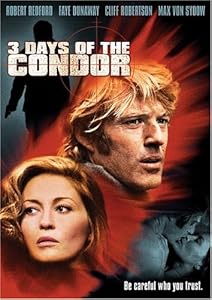
Here's one that predates even me, old fart that I am. "Three Days Of The Condor" is a 1975 film from Sydney Pollack starring Robert Redford, Faye Dunaway, Cliff Robertson and Max Von Sydow. It's in that genre I find hard to get enough of - paranoid spy thrillers.

I've learned over the years that I like Robert Redford in about anything, and when I found out he was in a spy film from just before I was born, well, needless to say I was intrigued. Add in the fact that it was a Sydney Pollack film (he's best known for directing "Tootsie" but he was a fantastic director and a great actor to boot) and you had my attention.

Redford plays Joe Turner, a CIA researcher out of New York, code named Condor. He's, well, he's a reader. It's his job to read magazines, novels, newspapers, etc., and to be on the lookout for clandestine messages hidden within. For example, he's reporting to the CIA about a novel he's reading, that isn't very good, but has been translated into a surprising number of languages, which is, in itself, somewhat unusual. He's not a field agent. He makes this very clear a number of times in the film. But he is very smart.

One day, he goes out to lunch and comes back to find his entire office murdered, and himself on the run. And he suspects the CIA may be trying to set him up. So he enlists the help of a woman entirely at random.

Part of what's so great about this film is the feeling that no one, and I do mean no one, is entirely trustworthy. The film wasn't long after Watergate, and while they were filming it, another bunch of scandals had come to light, pointing the finger clearly at the CIA. Pollack said a number of times that it just happened to be an interesting coincidence, as they were basically in post production when the scandal broke, and they simply got lucky.

The cast is excellent and Pollack gets mileage out of them. Redford is rarely less than great, and he's got a real sense of tension in this movie. I'd seen Dunaway in "Network" but it had been a while, and I was glad to see that "Network" wasn't a one-off and she portrayed a genuine sense of terror. And if you want a villain, well, Max Von Sydow practically wrote the book on that. He was Blofeld and Ming the Merciless. I mean, c'mon.

Redford would revisit the spy role a number of other times in his career, and I'm sure we'll get to some of those films at some point in the blog, but for now, I leave you with the trailer for "Three Days Of The Condor."

(There was a book first? Hmmm....)

Wednesday, March 12, 2014

Once A Thief - 1991

"Once A Thief" is not the kind of movie you would expect from Hong Kong action maestro John Woo, and it came in between two very different movies, 1990's "Bullet In The Head" which was about concentration camps and 1992's "Hard Boiled" which is sort of the apex of the John Woo super violent ballet, both of which are excellent films. In the middle, however, you'll find "Once A Thief," which is a heist comedy, and I do not use the term "comedy" mockingly, because the film is pretty damn funny. In fact, in a lot of ways, you can see "Once A Thief" as the predecessor of the entire genre that Stephen Chow built, that sort of wacky, nonsensical comedy that doesn't really have to obey any rules of reality.

The story is about three orphans who have been quasi-adopted by, get this, both a crime boss and a police officer. They train to be thieves, but eventually want to get out of their life of crime. All the basic things you want out of a John Woo movie are here - big action set pieces, shoot outs, flashy cinematography, doves, fire, reflections... but you also get a delightfully weird romantic triangle, and comedy that veers between slapstick and dry wit at a moment's notice. And, it stars Chow Yun-Fat, who I will watch in pretty much anything...

The film is just so different than a lot of Woo's other works that many people may find it hard to believe that the man who brought us "Face/Off" would get caught up in what can only be described as "The Thomas Crown Affair" meets "Kung Fu Hustle" but Woo's a very talented and flexible guy. Don't believe me? Check out his mega-epic period film "Red Cliff," which was gorgeous to look at and amazingly constructed. Sadly, it seems like Woo's left Hollywood for good, but at least he's still making movies.

Sunday, March 09, 2014

Wanted - 2004

I very much have a love/hate relationship with Mark Millar as a writer. On one hand, he's written a bunch of books I've really liked over the years. On the other, his public persona is all the worst aspects of P.T. Barnum and Billy Mays mixed with a WWF wrestler from the 1980s. (If you think I'm kidding about this, you need only read one of the missives he puts down in the back of any single issue of his comics of the recent years, where he talks about how everything he has coming out is better than anything ever put out in the history of comics. Seriously.) Add in the fact that when he's off, he's really off, and you have a writer I feel like I need to consider quite carefully before I pick anything of his up.

All that said, "Wanted" is one of my favorite books of the last decade. There was a movie made about it that was good, but veered so much from the source material as to be almost unrecognizable.

"Wanted" is about supervillains.

The concept isn't all that complicated - it's a world without superheroes, and the supervillains have taken over, but they aren't all crazy and in the limelight. They've learned that the best way to rule is from the shadows, and while they get occasionally crazy, they also tend to keep a lot of it in check and under the covers. They're sort of like the Mafia and the CIA all rolled into one, but, y'know, with super powers.

Wesley Gibson is the protagonist of the book, and also the narrator, although there are a lot of points where you feel like Wesley is doing an impersonation of the narrator of Chuck Pahalniuk's "Fight Club," all self-loathing and nihilism and despondency. Wesley, as it turns out, is also the son of the late great, Killer, one of the most powerful supervillains out there, who was recently assassinated. The Fraternity (which is what the organization of supervillains is called) want to recruit and train Wesley to take his father's place, and to help them find out who killed their father.

In a lot of ways, Wanted is a classic hero's journey told from the flip side. Instead of teaching Wesley how to be good and noble, they teach him how to be evil and self-serving, how to not only endure violence but how to revel in it. And, like the classic hero's journey, they teach him how to fight, which comes pretty naturally to him.

As you read Wanted, you're probably going to feel pretty conflicted about how you feel about it, which is good. Wesley turns from walked-all-over to one-doing-the-walking relatively quickly, and a reader with any moral compass at all will say he's overcompensating and going too far in the other direction, which is of course the point. Wesley reaches the depths of humanity and keeps on digging, committing murder, theft and other horrible acts pretty mindlessly, without seeing it have really much of an impact on Wesley's psyche. It's the story of a supervillain told by a supervillain who doesn't have any regrets over what he's become, and has contempt for anyone who can't do what he does. The book's going to make you feel a little squeamish, and that's by design. Millar wants you to see what life would be like for a supervillain who got away with living that sort of life, and J.G. Jones turns in an absolutely amazing collection of art. Jones is mostly a cover artist these days, much to my sadness, because he knows how to fill up panels with all the details they need, and how to pull focus in dramatic angles and lightning like a good film director, and "Wanted" is him firing on all cylinders. At some point, I hope to track down one of his original pages from either "Wanted" or the "Marvel Boy" miniseries he did with Grant Morrison.

The other great thing about "Wanted" is that it's a self-contained story - you don't need to get any other books, and I don't think we're likely to ever see a sequel, which is fine. This book tells you the entire story you need, and you don't need a page more. "Wanted" is sort of the end-of-the-line of the approach that "Watchmen" and "Dark Knight Returns" were putting forth in the 1980s - this is as dark and gritty as you'll ever need to get. But it's also a hell of a story. This one Millar hit out of the park. Just don't get me started on how much I hate "Superior."

Wednesday, March 05, 2014

The Spanish Prisoner - 1997

My love of the con is well documented at this point, but I also particularly love films that are mind games, and "The Spanish Prisoner" definitely falls into both categories. It's also from David Mamet, who is no slouch when it comes to these kinds of things.

Mamet has a very particular way of writing dialogue. It's flashy, it's showy, it's confident and sometimes it's a little weird. It's filled with questions that aren't, sentences that don't finish and people talking into one another. He also writes wonderfully cynical people with absolutely razor wits. One of my favorite Mamet-isms comes from the money "Heist," in which Danny DeVito says, "Everybody needs money. That's why they call it money." He writes vicious, targeted dialogue that doesn't pull any punches. Mamet also writes in circles, elliptical wandering sentences that talk around subjects without actually talking about them, in such fascinating sentences as "Beware all enterprises that require new clothes." I mean, it sounds deep, but is it? Isn't it? Mamet's dialogue is like a puzzle, something to be pieced together, constructed and then dissected, torn apart until the truth shines through, except that the truth in any other light might be a lie. (Sorry, listening to Mamet and reading Mamet inevitably leads to writing a little like Mamet.)

The spark of the story is simple - Joe has invented a formula, or a process, or, well, something. Something that a lot of people with a lot of money are willing to pay a lot of money for, because they think it will bring them even more money. From there, well, things get a little tricky, and I certainly wouldn't want to spoil the fun.

I remember checking this movie out initially because it had two things I liked, a David Mamet con game and Steve Martin. I'd been reading about Steve Martin saying how he was going to try things other than comedy, and "The Spanish Prisoner" was one of the first films I'd ever seen where he wasn't out for laughs, and he made an excellent player in one of Mamet's shell games played with Russian nesting dolls. He's quite lovely in this film, playing his film with just the perfect amount of inscrutability.

And, of course, like most David Mamet films, it also features the wonderful Ricky Jay. Ricky Jay's done a ton of incredible things over the years, and I'm still annoyed there isn't a way to pick up the fantastic television special that Mamet directed called "Ricky Jay And His 52 Assistants." Ricky Jay, you see, is a slight-of-hand magician, and can do things with a deck of cards you simply wouldn't believe. Oh, you lucky people. While I was writing this, I decided to look and see, and sure enough, there's the whole special, free on YouTube. It's an amazing piece of sleight-of-hand and showmanship. He's playful, witty and a devilish raconteur. I've always wanted to see one of his shows live. Maybe some day. But there's a whole show for us all, on YouTube. The internet is a wonderful thing. Here it is, for when you have the time.


Perhaps the only thing that I'm not particularly fond of in "The Spanish Prisoner" is the only  thing that I'm not fond of in a lot of David Mamet's work - the acting of his wife, Rebecca Pidgeon, whose acting always feels overly stilted to me. I've seen her in a bunch of stuff he's done, and I always feel like whatever part she's playing would be better served by a different actress. Maybe it's just something about her delivery. She's fine, I just think there could be better.

If "The Spanish Prisoner" appeals to you, there's a wealth of Mamet films you can get later, including "Heist" and the classic "House of Games." Mamet's also written a bunch of plays and movies that he hasn't directed, choosing simply only to scribe them, many of which are very good. You should look into them.

Sunday, March 02, 2014

Grosse Point Blank - 1997

There is something intrinsically weird about Grosse Point Blank as a movie, and I think that's why it's wonderful. It was made during the second renaissance of John Cusack, where he did High Fidelity and Grosse Point Blank almost back to back, both of which were projects that absolutely sailed, and for highly different reasons. We need to get this John Cusack back, the one who knows how to pick the smart projects.

The premise of the film is surreal to start with. A hitman is invited to his ten year high school reunion. Coincidentally enough, he also has a job there. And, on top of everything, he's dealing with an impeding assassins union struggle (no, really) and his therapist won't return his phone calls. The guy's a mess, but then again, who isn't around the time of their ten year high school reunion?

I didn't go to mine, because I wasn't invited, but my twenty year is coming up next year, and I'll probably go to that, and I expect it to be as strange and unusual as the one Cusack's character goes to here. (One of the lines in the movie is "It was like everyone had swelled.") But before he gets to the reunion, he's going to try and reconnect with his past - the best friend he left behind, the girl he left on prom night, the house he grew up in. Needless to say, none of this goes as planned.

Yesterday I was talking about ensemble casts, and Grosse Point Blank really is an embarrassment of riches in this regard. Dan Aykroyd plays the guy trying to talk Cusack into joining his little assassin's union, Alan Arkin is Cusack's reluctant therapist, Jeremy Pivens is the best friend who's trying to figure out what the hell is going on and Minnie Driver is the girl he left behind. Oh, and John's sister Joan is his assistant/partner-in-crime. Hell, even Hank Azaria's in the movie.

The film is filled with crackling dialogue and wonderful fish-out-of-water moments made even funnier by the fact that it's an assassin in suburbia. HIS suburbia, rather, or the one he grew up in. But while he's been gone for ten years, his hometown has changed, and more than he'd expected, from the girl he left behind (who's a radio DJ now) to the house he grew up in.

Grosse Point Blank is also flush with the best possible 1986 soundtrack you could put together, from the mainstream stuff like a-ha's "Take On Me" to the popular but somewhat indie stuff such as Echo & The Bunnymen's "The Killing Moon" or Faith No More's "We Care A Lot." The music for the film was so good they put out not one, but two soundtracks to it.

The star of the show is John Cusack, though, who plays the man adrift better than I even thought possible. This is a guy who's been trying to find himself for the last few years, after having lived a life doing some pretty bad things and telling himself he was doing it for the right reasons. He goes through so many different phases in this movie, it's kind of remarkable to watch, even as he's trying to see whether or not he can blend in with the life he left behind. He gets to play: frantic, subdued, tortured, ecstatic, nervous... in fact, it's a little like high school all over again. There's also an amazing thirty second scene where he's interacting with a baby, and it's almost like a capsule of the entire movie told purely through facial expressions.

We'll revisit Cusack a number of times in the deviations, but I can never believe when people tell me they haven't seen Grosse Point Blank. It's such a perfectly strange mix of pathos, humor and nostalgia, it's gotta be high school all over again...

Saturday, March 01, 2014

Now You See Me - 2013

Hey, there's nothing that says I can't talk about recent stuff, and I don't think enough people saw "Now You See Me" for it to pass unnoticed. So, my love for a good heist film is certainly on record, and I enjoy stage magic as much as the next guy, which is part of why "Now You See Me" is so much better than you might expect. Part of why.

The premise of the movie is that four magicians, used to working on their own, team up and start committing crimes in a theatrical way under the pseudonym "The Four Horsemen," and the FBI is trying to figure out not only how these magicians have turned into master thieves, but also why they're doing it, and how they can stop them.

I don't want to talk too much about the movie itself, because that would spoil the fun of it all, but let me just tell you this - ensemble casts require a lot of great actors, each willing to play into their part and never try and steal the spotlight, and this cast does that wonderfully. Jesse Eisenberg plays the control freak, Isla Fisher the neo-punk, Woody Harrelson the mentalist, Dave Franco the rookie, Michael Caine the bankroll, Mark Ruffalo the fed, Melanie Laurent the international fed and Morgan goddamn Freeman as the debunker. Each of them gets their moment to shine, but the film is at its best when two or three of them are interplaying off of each other. There's a wonderful scene early on between Eisenberg and Ruffalo in an interrogation room that is just delightful to watch. The writing gives actors a chance to riff back and forth and build an easy rapport, and the film gives that space to breathe, letting the characters develop even as the story goes along. It's also not a film that force feeds things, letting the audience fill in some of the gaps from bits and pieces.

"Now You See Me" was, apparently, a 'sleeper hit,' in that it didn't generate a lot of noise, but a number of people went and saw it. Hell, it's the first film in a long time that I actually went and saw in the theater TWICE. And, I'm pleased to discover that a sequel was greenlit, so that's pleasant to find out, because this cast worked great together, and I look forward to seeing what comes along in the next iteration. The film isn't for everyone, though, as some people on IMDB called it "pretentious" and "idiotic." I find the film delightful and am willing to go along for the ride, but hey, some people want their plots to be so perfect that you can't pick it apart. (Those people don't do well in heist films, I've found, because they get annoyed by luck, chance, planning done off-camera, details the director didn't show for sake of dramatic revelation, etc.) Me, I'm fine with having some popcorn fun that sucks me in for a few hours, and to the people who didn't like "Now You See Me," well, you don't have to go to the sequel. Me, I can't wait...

Tuesday, February 25, 2014

The Hudsucker Proxy - 1994

"You know, for kids."

That's sort of the catchphrase of the movie "The Hudsucker Proxy," the subject of today's deviation. It's a 1994 film from the Cohen brothers, and starts Tim Robbins, Paul Newman and Jennifer Jason Leigh, and it's, well, like a lot of the Cohen brothers movies, it's a film out of its time.

The Cohen brothers have done a lot of films that people know really well - Fargo, No Country For Old Men, Burn After Reading, O Brother Where Art Thou? and, my personal favorite, The Big Lebowski, but they also made a bunch of films that just didn't get the same level of attention, the best of which, in my personal opinion is The Hudsucker Proxy.

Part of the joy of the Cohen brothers is that they make movies from another era. Burn After Reading, for example, is a screwball comedy but done in the sort of Reagan-era Commie paranoia fearmongering in the eighties. The Big Lebowski is set in the early 90's, but is meant to evoke the sort of meandering plots of Raymond Chandler. It was, for lack of a better term, stoner noir.

The Hudsucker Proxy is also a screwball comedy, but one that seems to be somewhere between a Frank Capra film and a Mel Blanc Looney Tunes cartoon. It is definitely about big business, the little guy, rags-to-riches and the bizarre success of simple.

It's about the hula hoop. Sort of.

It feels like the kind of film you would've seen made in the 1940s, but with a very post-modern take. Tim Robbins is Norville Barnes (what a name, right?), a small-town guy with big ideas in the very big city, and he gets a job as a mail clerk, and before you know it, he's running the company, although not the way he intended and not for the reasons he thinks he is. See, Paul Newman is attempting to use Tim Robbins to run the company into the ground, so he can buy up the stock cheap and then rebuild it. But Tim Robbins has an idea, and since he's in charge of the company, he's gonna make it.

The weird charm of the picture is hard to encapsulate into a handful of words, but it's certainly not a film for everyone. A lot of critics at the time didn't care for it. They thought it was all style and no substance, or that the film lacked humanity, but to my eye, I think a lot of the critics missed the point. The style IS the substance, and the film has humanity in spades, but it's a simpler, less modern view of humanity. It's almost a fable in its elegant simplicity, and it's a pitch-perfect echo of the films it is shadowing. Those critics forget that a Frank Capra film seen through a modern lens looks, well, a little to "aw shucks" to be genuine, because those were simpler times. That's what this movie is trying to evoke.

I could get into the reasons I find so much of it delightfully hilarious, but explaining comedy isn't often a wise approach. Either the movie will speak to you or it won't, and it does to me. Hell, there are a bunch of actors in this movie that do more in a handful of scenes than some actors do over an entire career. (Particularly watch for Bruce Campbell killing it as "Smitty," a member of the newspaper staff.)

Gotta hand it to the Cohens - they like to be different.